Most family searches in the former Russian Empire stall on one line: the place. A ship’s passenger list says “Russia”. A naturalisation file names a province, or a town spelled the way an immigration clerk heard it. A village name, when there is one, can be bent almost beyond recognition.
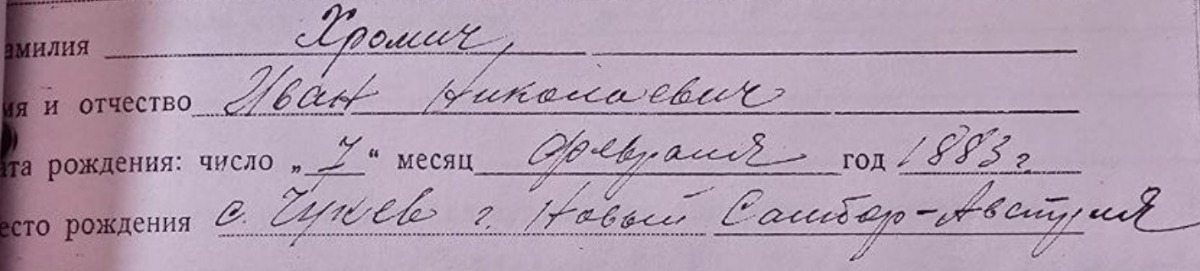
Take one family we worked with. A Soviet file of 1938 gave their great-grandfather’s birthplace as “the village of Chukev, Novy Sambor, Austria”. Read with Polish spelling in mind, Chukev is Czukiew, near Sambor (long called Nowy Sambor) in Galicia. When he was born, Galicia belonged to Austria-Hungary. After 1918 it became part of Poland, after the Second World War part of Soviet Ukraine, and today the village is Chukva, Lviv region, Ukraine. His baptism was not in a Ukrainian archive at all, but in a Polish one: the Central Archives of Historical Records (AGAD) in Warsaw. One village, four states, and the record sat in none of the places the family would have looked first.
Records were not kept by village. Births, marriages and deaths were written down by the parish, and the books are filed under the church, in the archive of the region the parish belonged to. So to find a record, you need three addresses for the same place:
- The village as it was named then, with its district (uezd) and province (guberniya).
- The parish it belonged to, and that parish’s faith.
- The archive that holds the parish books today.
The village, and often its parish, you can find yourself, even without a word of Russian. The archive and the books themselves mostly live in Russian sources. This guide takes you through all of it in order, from a half-remembered name to your ancestral village and its records, and says plainly where the Russian starts.
If you have already tried Ancestry or MyHeritage and come up empty, our article on why Russian ancestors don’t show up there explains why. This guide picks up where it leaves off.
Start with what your documents say
Collect every version of the place name you have: ship manifests, naturalisation papers, Soviet passports and files, letters, gravestones, the way your grandmother said it. Keep them exactly as written, mistakes included. If everything you have only says “Russia”, look again at the documents of arrival: naturalisation files, passenger lists, military and refugee papers usually give at least a town or a province, in some spelling.
Write down the date and the source of each one. A name is only true for its year. If the document is late, a Soviet passport or a 1950s file, the place may already have been renamed, and you need to work back to its old name. If the document is early, an emigration paper from 1905, the name is the old one, and you need its modern name to find it on today’s map. Treat your list as a timeline, not as a set of contradictions.
Why the name looks wrong
It was written down by people who didn’t speak the language
A clerk in Hamburg, New York or Paris wrote what he heard, in his own alphabet. The same Russian sound turns into different letters in each language:
| Russian | German | Polish | English / French |
|---|---|---|---|
| ч | tsch | cz | ch, tch |
| ш | sch | sz | sh, ch |
| х | ch | ch | kh, h |
| в | w | w | v |
| й, я, ю | j, ja, ju | j, ja, ju | y, ya, yu |
So Tschernigow, Czernihów and Chernigov are one town, and a village can hide behind four spellings before it reaches you.
The map kept changing
Before 1917 every place had an address of three or four levels. Family documents usually keep only one of them, and often the wrong one.
| Level | Russian | Roughly | What to know |
|---|---|---|---|
| Province | губерния (guberniya) | A region | Named after its capital: Tver province, Kiev province. “Kiev” (today Kyiv) on a paper may mean the province, not the city |
| District | уезд (uezd) | A county | Also named after its town. Place directories and archive catalogues are organised by uezd |
| Township | волость (volost) | A group of villages | Peasant self-government, for all peasants from 1861. Soviet papers often name the volost instead of the uezd |
| Settlement | село, деревня, местечко | Village, hamlet, small town | Selo usually had a church, derevnya usually didn’t. Mestechko is the shtetl |
Then the whole map was redrawn, again and again:
- 1917–1923. New provinces were cut, old ones split. Poland, Finland and the Baltic states left.
- 1923–1929. The Soviet reform replaced uezds and volosts with districts (raion) and regions (oblast). This is why a 1930s document names a raion that didn’t exist in 1910.
- 1939–1945. Western Ukraine, western Belarus, the Baltics, part of Karelia and Bessarabia changed countries, some of them twice.
- After the war. Villages were renamed, merged or emptied: Crimean Tatar names in 1944–1945, Finnish names on the Karelian Isthmus, German names in Königsberg region.
Step 1. Identify the village
Narrow it down from the top
Some village names repeat across the whole empire: there are Petrovkas, Ivanovkas and Pokrovskoyes from Poland to Siberia. So never start from the village name alone. Work from the top: first the province, or at least today’s region; then the uezd; then the volost; only then the village. Use everything you know to get there: a town or a river from family stories, a province named in any document, the family’s faith (a Catholic family in an Orthodox village is unlikely), the father’s estate.
Spell it the way local records did
For most of the empire that means Cyrillic: old maps, Russian Wikipedia and Russian sites only search in Cyrillic. Convert each spelling with the table above or any Latin-to-Cyrillic transliteration tool, and try several versions: “Chukev” becomes Чукев, “Tschernigow” becomes Чернигов. In the former Kingdom of Poland and in Galicia, try the Polish spelling too: records there were often kept in Polish or Latin. You don’t need to read a language to compare letters on a screen.
Look up the candidates
- FamilySearch. The shortcut, in English. Search the catalogue by place: if the parish registers for your village were filmed, you will see them straight away, and you can jump to Step 4.
- Familio. The one Russian site worth learning, even without the language. Unlike MyHeritage or Ancestry, it is built around places, not people. Each village has a page where volunteers link what they find: the parish it belonged to, the surnames that occur there, and surviving sources from metrical books to censuses. Only what volunteers have added is there. The search shows every village with your name, with its uezd and province, so you still have to pick yours. It is in Russian only, but browser translation is enough to find your way around.
- JewishGen Gazetteer, a database of place names in English that searches by sound. It lists today’s villages across the former empire, but the historical detail is richest for the Pale of Settlement: today’s Ukraine, Belarus, Lithuania, eastern Poland and Moldova.
- Wikipedia. Try English first, then Russian, Ukrainian or Polish with your browser’s translation. Village articles often give the former names and the uezd.
Check them on an old map
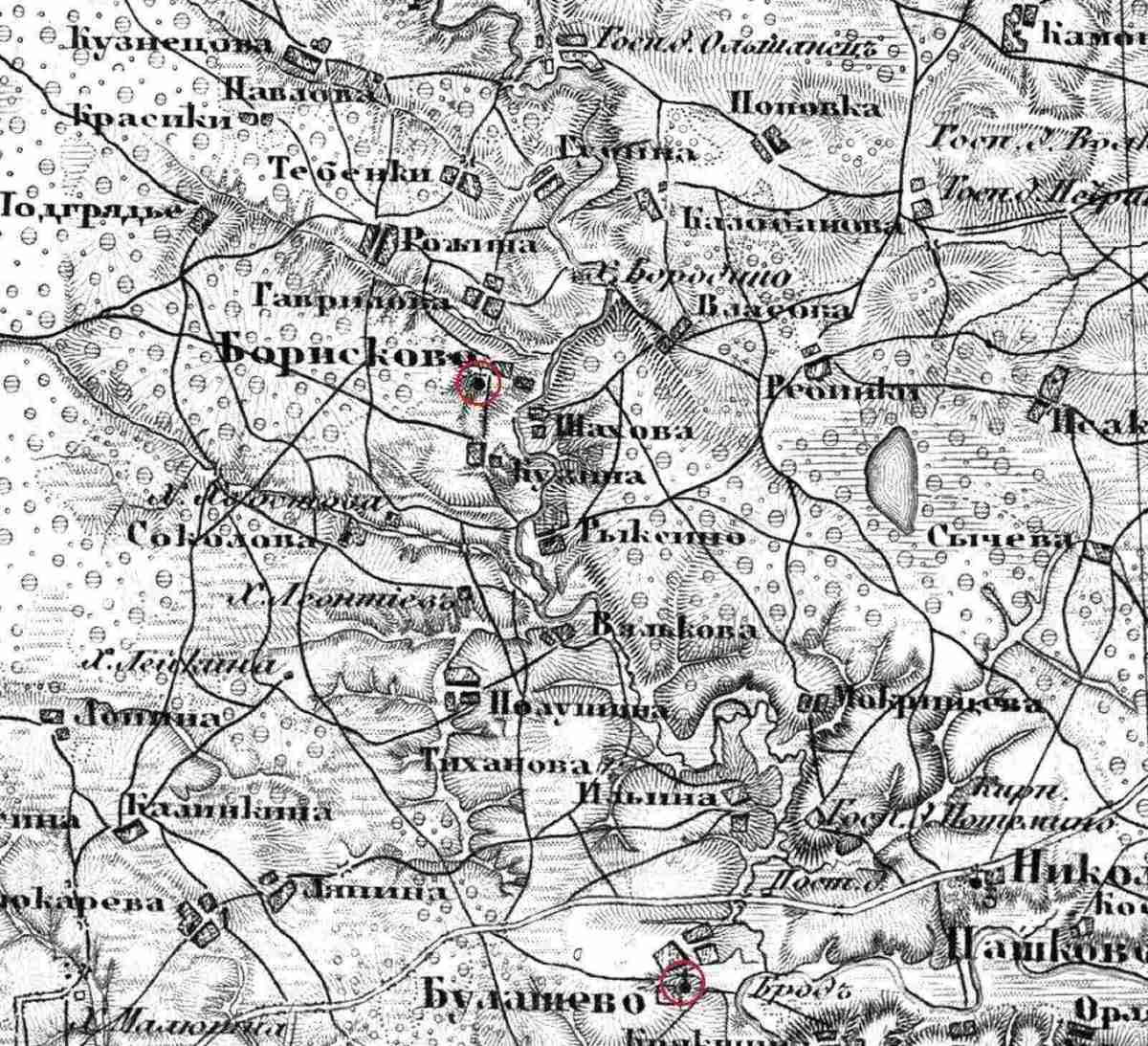
etomesto.com collects old maps of different years and lays them over a modern map and a satellite view. Find the area, look for the name you prepared, and see what stands there now. For anyone who doesn’t read Russian, this is the most useful tool of all: you are matching letters and shapes, not reading sentences. The map shows you three things at once:
- Where the village was, and what it is called today.
- How the borders moved. Maps of different years show the old provinces and districts, so you can see which uezd your village was in at the date of your document.
- The churches around it. Church villages are marked, and you need them in Step 2.
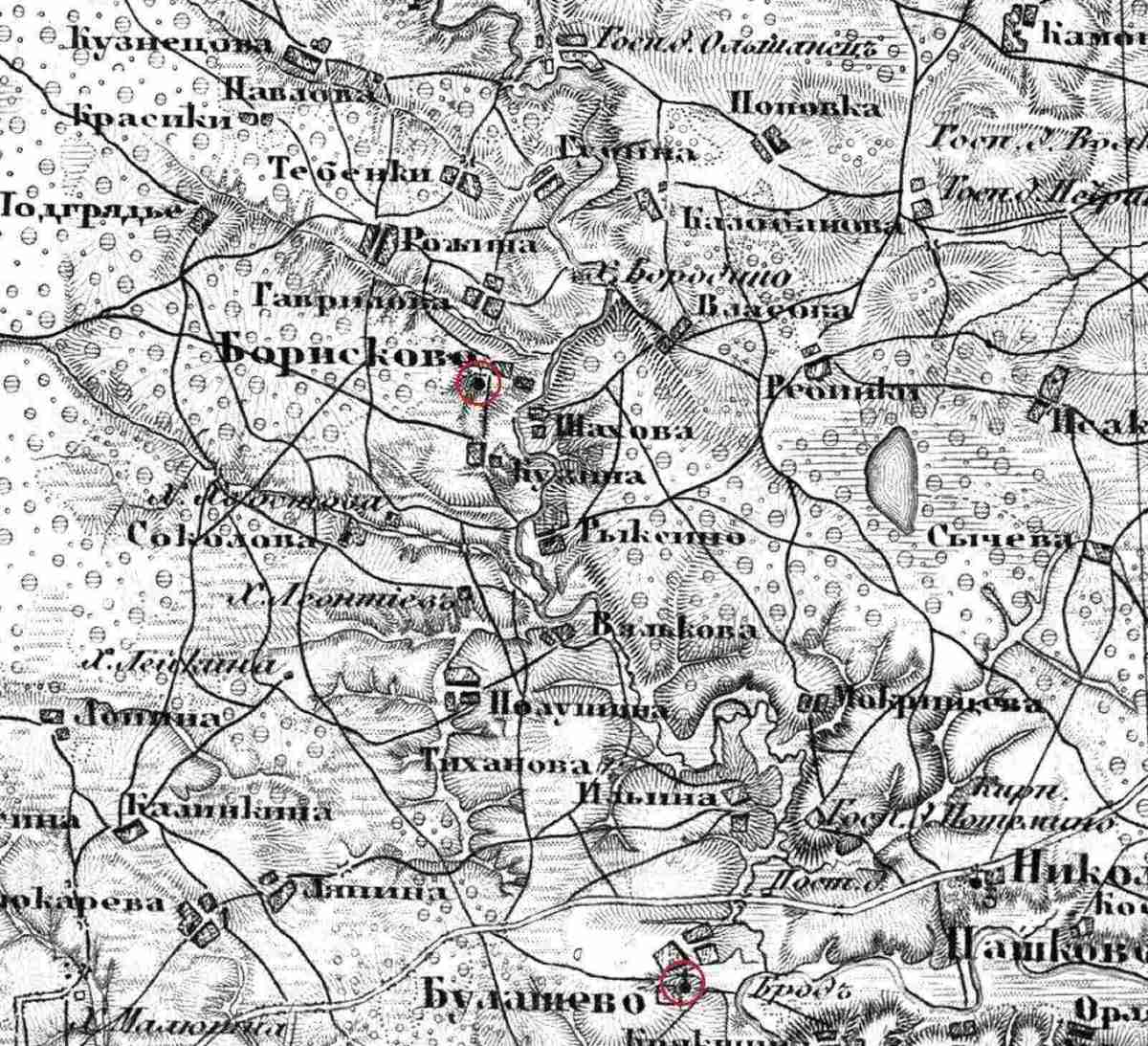
By the end of this step you should have the village’s old name, its uezd and province, and its place on today’s map.
Step 2. Shortlist the parish
A selo usually had its own church. A derevnya was served by a church nearby, and nearby is not always the nearest. Your candidates come from three places:
- The old map. Look at every church village around yours. Sometimes there are two churches within a kilometre, and you need to check both.
- Familio. The village page often names the parish.
- Your family’s faith. Catholic and Lutheran parishes were larger, so the church can be further from the village. Jewish metrical books were kept by the crown rabbi of a town, not of a village, and often in the town the family was registered to rather than the one they lived in.
If your family lived in a town
In a town there can be dozens of churches, and St Petersburg or Moscow had hundreds. Most families went to the parish church of their street, so an address narrows it down: find it on an old city map on etomesto, because many of the churches around it no longer exist. Address books such as Весь Петербург (All Petersburg) and Вся Москва (All Moscow) list residents year by year and can give you that address, but they are in Russian and in old typeface. And people did not always go to the nearest church: a family might keep to the one it had always used, a more prestigious one, one linked to the father’s regiment, school or workplace, or simply one they liked.
Parishes moved too
A new church could take villages away from an old parish. A village that belonged to one church in 1850 might belong to another in 1890. Check the candidates for the years you are searching.
If you still have no candidate, the answer is in documents that list which villages belonged to which church: provincial place directories and the annual clergy registers of each church. They are in Russian, often handwritten, and mostly kept in archives. This is one of the places where a researcher who reads them saves weeks.
By the end of this step you should have one to three candidate churches.
Step 3. Find the archive
The archive depends on the region the parish belonged to, and that is where many searches go wrong. The same village often carries different addresses in different papers: a Soviet passport gives one oblast, a 1920s document another, a pre-1917 record a province with a third name. The region you happen to know is not always the one whose archive holds the books. Work out every region the village belonged to, then check each of them:
- Poland and Galicia. Polish state archives publish many parish registers online at szukajwarchiwach.gov.pl, and AGAD in Warsaw holds many Catholic registers from Galicia.
- Ukraine. Ukrainian archives have opened a large part of their metrical books, and many are online.
- The Baltic states have their own open online portals for church records.
- Belarus, Russia and everywhere else. See whether FamilySearch or Yandex Archives has registers for that region and that parish.
If none of them has your parish online, the books are most likely in a Russian or Belarusian archive and have to be requested from it, in Russian. That is usually the point to bring in a researcher.
If the books aren’t where they should be
- Look for the second copy. Every metrical book was kept twice: one copy in the parish, one sent to the diocesan consistory in the provincial capital. If the parish copy burned, the consistory copy may survive, and it can be in another region’s archive, or another country’s.
- Think about the army. If the father served, his children may have been baptised in a regimental church. Military churches kept their own registers, outside the diocesan system, and the second copies of many of them were sent to St Petersburg, the capital. So a regimental baptism may be in a St Petersburg archive, wherever the regiment was stationed.
- Accept that some books are lost. Survival is uneven. Fires and wars destroyed whole series in some places; in others, St Petersburg among them, most books survive.
Step 4. Open the books and confirm
Open the metrical books of each candidate church for the years you need. Each entry names the parents’ village, so the book confirms the parish itself: if your village keeps appearing, you are in the right place. Our guide to Russian metrical books explains how to read an entry, column by column. The books are handwritten, in Russian, Polish, Latin or German depending on the faith and the years. If the hand defeats you, this is the step where a reader of old Russian makes the difference.
What you can do without Russian
Most of Steps 1 and 2: decode the spelling, find the village on an old map, see where it is today, list the churches around it, and check FamilySearch and Familio with browser translation. Steps 3 and 4 happen in Russian: archive catalogues, requests and handwritten registers.
Frequently asked questions
What is a guberniya and an uezd?
A guberniya was a province of the Russian Empire, an uezd a district within it. Both were abolished by the Soviet reforms of the 1920s, but archive catalogues and old directories are still organised by them.
The village doesn’t exist any more. Can I still find its records?
Often, yes. Records are filed under the parish, not the village, so they don’t depend on the village surviving. Old maps and Familio will show you where it was and which churches stood around it. Whether the parish books themselves survived is another question: some did, some didn’t.
Why does my ancestor’s village appear in two provinces?
Either there are two villages with one name, or the borders moved: a district could pass from one province to another. Check the date of each document against the date of the change.
When to ask for help
If you found the village on the map and FamilySearch has its parish registers online, you can carry on yourself. Most families get stuck one step later: the parish isn’t clear, the books aren’t online, and everything from here is in Russian, handwritten, or held by an archive that is hard to reach from abroad.
That is exactly where our Initial Search (€180) starts. We sort out what is documented and what is still legend, establish the village, the parish and the archive that holds its books, and tell you what can realistically be found. The fee counts toward a full project if you go on.
One place name that nobody can identify, or two documents that point to different villages? That is a Family Mystery Investigation (from €250): one question, worked through to a documented answer. Investigate a family mystery →