You built your family tree, took the DNA test, subscribed to Ancestry or MyHeritage. The branches that settled in France, Germany, Britain or across the Atlantic unfolded beautifully — censuses, arrival records, naturalisation files, all a click away.
Then you reached the ancestor who came from the Russian Empire, and the trail went cold. Maybe a naturalisation dossier or a passenger list, with a birthplace spelled three different ways. Behind that — a wall.
The wall is not your fault, and it isn't because the records don't exist. They exist — millions of them. They're just not where the platforms can reach them.
One case from our files shows why. A client came to us knowing nothing about her great-great-grandmother — no name, no date, no place, only a family story that the woman had been Swedish. We found her in a single day without leaving our desks, and every step ran into one of the reasons the platforms fail. The case runs through this article in pieces, each beside the problem it illustrates.
Why Ancestry and MyHeritage have almost no Russian Empire records
Ancestry and MyHeritage are search engines over digitized, indexed collections. They are spectacular for countries where records were centralized and microfilmed decades ago. The former Russian Empire is a different planet.
Nothing was centralized. There is no Russian national archive of births and deaths. Vital records — the metrical books kept by churches, synagogues and mosques before 1918 — sit in hundreds of regional archives across Russia, Ukraine, Belarus, the Baltics, the Caucasus and Central Asia, each with its own catalogue, its own rules and no budget to digitize.
Almost nothing is indexed. There are exceptions, and they are growing: FamilySearch microfilmed and partly indexed several regions decades ago, and Yandex Archives now publishes scanned registers with machine handwriting recognition that works better every year. But these are islands. For most of the empire what exists is an image of a handwritten page — 19th-century clerical cursive and old orthography that native speakers struggle with, mixed with Hebrew, Polish, Latin or German depending on the confession. Nothing searches that. Someone has to read it. (What a metrical book entry actually contains →)
Borders and names kept moving. A village may have belonged to three states in one century, and its records may sit across a modern border. Platforms match strings of text; this puzzle needs someone who knows the administrative geography.
The case, part one
With no name to search for, we started with the men: the client knew her great-great-grandfather, Nikita Vybornov, and their son Mikhail, born around 1904 somewhere in Finland.
Mikhail surfaced in the Soviet WWII military databases, which record biography as well as service — and his file gave a birthplace: the village of Hötylä, Tavastehus district. (It gave the family a good deal more besides, none of which they had ever been told; that part of the story is here →.)
The real work started there, on a map. In 1904 that village lay in the Grand Duchy of Finland, then part of the Russian Empire; its capital Tavastehus is the Finnish town of Hämeenlinna today, and the old name is Swedish because these lands had belonged to Sweden for centuries. Three names, three states, one century — and until you know which country a village was in during which decade, you don't know which archive to write to, or in what language.
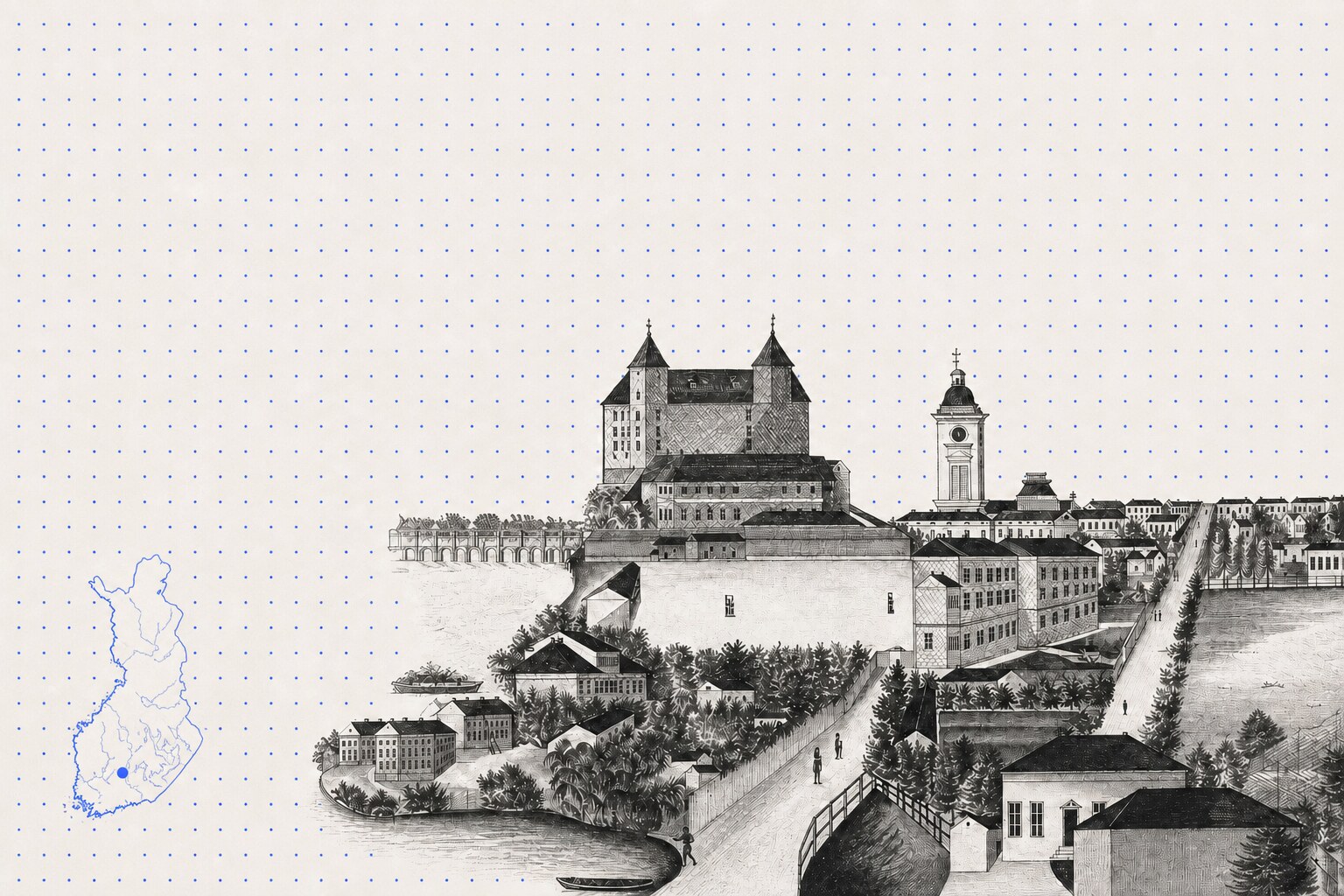
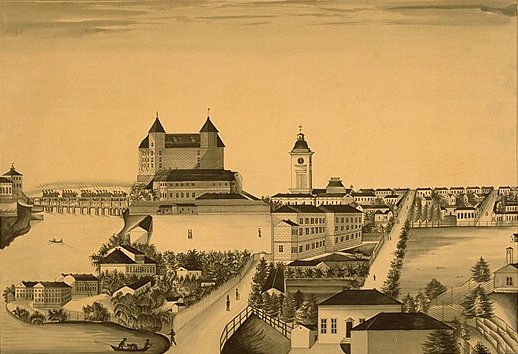 Historical image of Tavastehus fortress.
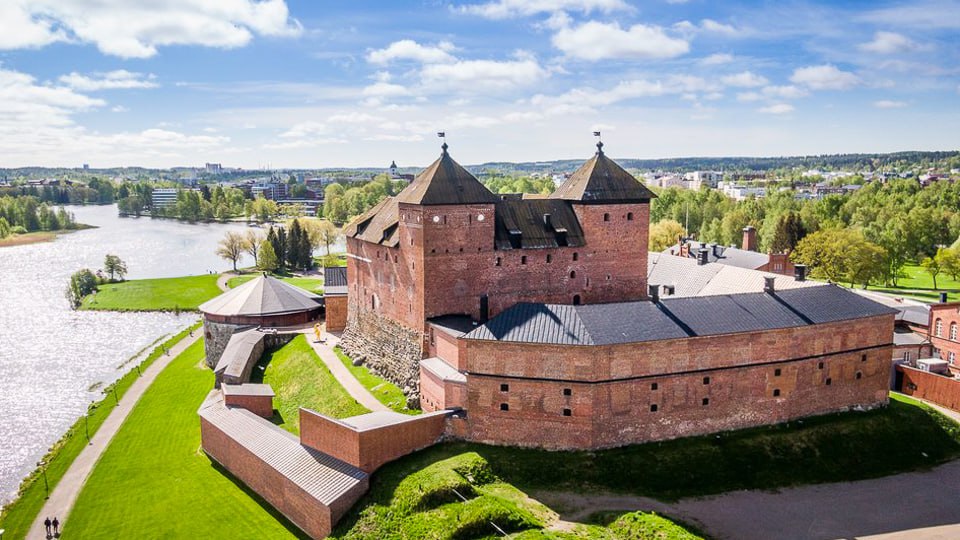 Modern view of Hämeenlinna Castle, formerly Tavastehus.
What Russian records Ancestry and MyHeritage actually hold
It isn't nothing, and knowing where their coverage ends saves you weeks.
They are excellent on the emigration side — manifests, naturalisation files, censuses in the country of arrival — and that is where your research should start. They cover the western provinces reasonably well: parts of today's Poland, Lithuania, Latvia and Estonia, digitized earlier than the empire's interior. MyHeritage in particular holds substantial Polish collections and the LitvakSIG corpus of Lithuanian-Jewish records, 1795–1940, plus a large layer of family trees built by Russian-speaking users before 2022 — largely frozen since, but someone else's tree can still hand you a branch that was never digitized anywhere. And DNA matching is often more useful than their record search.
Where coverage is close to zero: central Russia, most of Ukraine, Belarus, the Volga region, Siberia, the Caucasus, Central Asia. In other words, most of the empire — and most of the families who left it.
The case, part two
The Swedish half turned out to be the easy half. Once we had a first name and patronymic, FamilySearch produced her christening record in minutes: Hilda Alexandra, born 11 January 1871 in Hollola, Häme, daughter of Karl Magnus Forsblom and Maria Charlotta Helsingius. On MyHeritage she was already standing inside a thousand-person family tree built by a woman in Sweden. And there was a photograph of her parents' grave - The photo had been taken by a volunteer for BillionGraves, a separate project that maps and photographs headstones; MyHeritage indexes it, so it surfaced in her results.
That is worth understanding about these platforms in general. Much of what they show you isn't theirs — it's someone else's index, someone else's volunteer project, plugged into one search box. Which is exactly why their coverage stops where it does: when nobody has built the underlying database, there is nothing to aggregate.
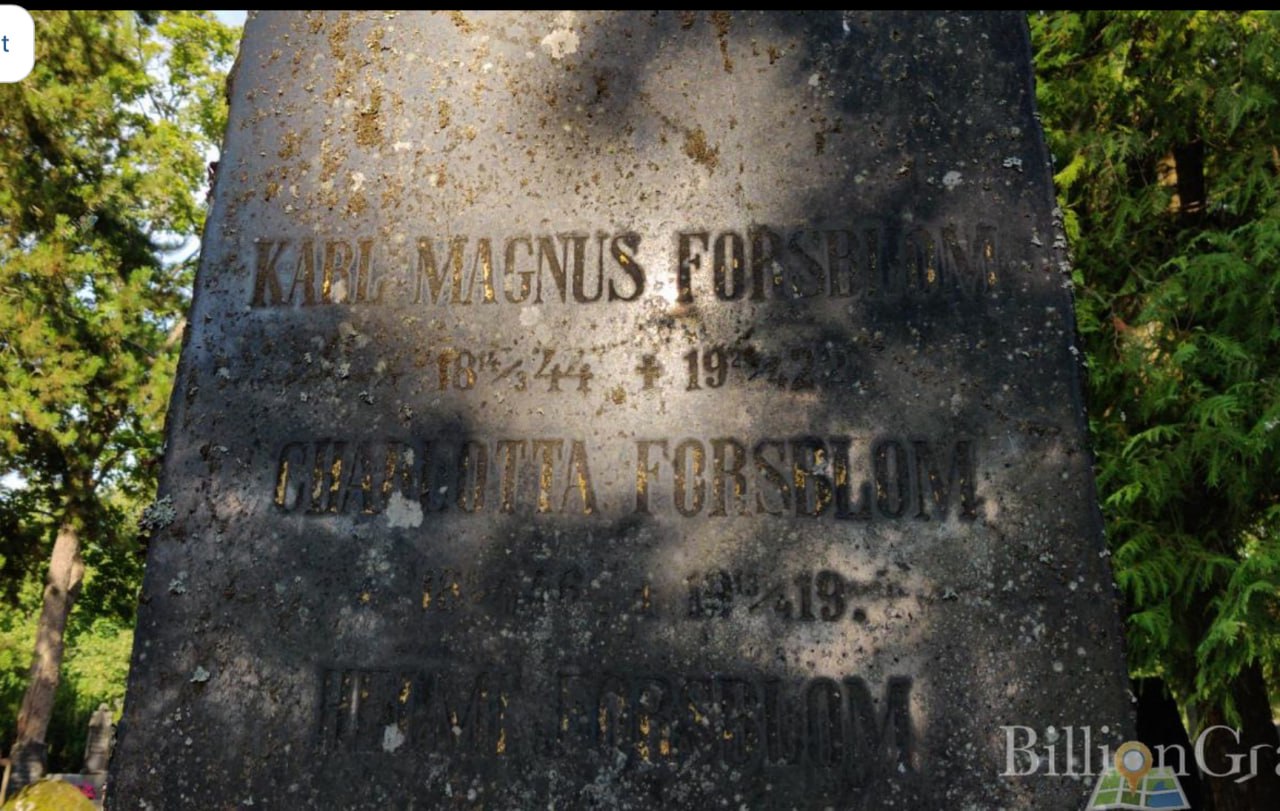 Her parents' grave, photographed by a volunteer and searchable online — the kind of access that simply doesn't exist east of the border.
From there the line ran on into the Swedish archives, where her family and her Swedish relatives' trees were waiting. The legend was true — and by then it was documented.
None of that is a criticism of the platforms; it is exactly what they are built for. But we could only ask them the question after the Russian half of the puzzle was solved, and that half appears on no platform at all.
An index is not a register
This trips up experienced researchers, not just beginners. What the platforms hold, even in their best-covered regions, are indexed extracts: a name, a date, a place. What sits in the archive is the register — the whole page, the whole year, the whole parish.
| An index entry gives you | The original register gives you |
|---|---|
| Name, date, place | All of that, plus the father's rank and estate, the mother's family, godparents, witnesses, marginal notes added years later |
| One event | The siblings born either side of it, an uncle's marriage, a grandparent's death — on the same pages |
| A fact to record | The next generation, because godparents and witnesses were relatives |
An index hit is a pointer, not proof. It tells you which parish and year to open.
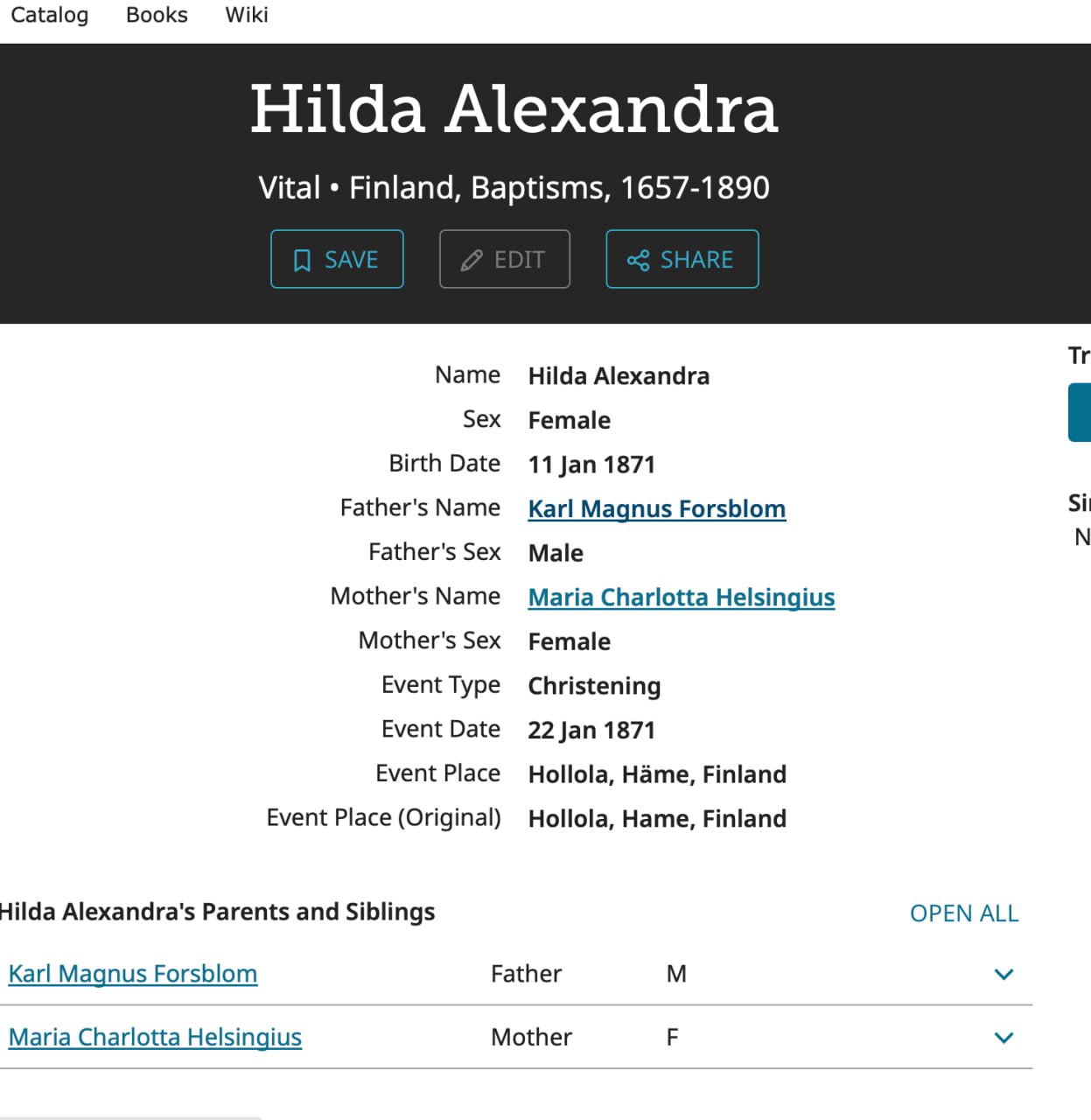 What an index gives you: a name, two dates, two parents. Everything else about her life is on a page in an archive.
The case, part three
Mikhail's father was Orthodox, so whatever his mother's faith, the boy would have been baptised in an Orthodox church — and Tavastehus had exactly two. We guessed the second copies of those registers might have ended up in St Petersburg. They had: the regimental church's books were digitized on the city archives' portal.
We paid for access and found Mikhail's birth — in 1902, two years earlier than his family — and his own wartime paperwork — believed. Here is the entry in full:
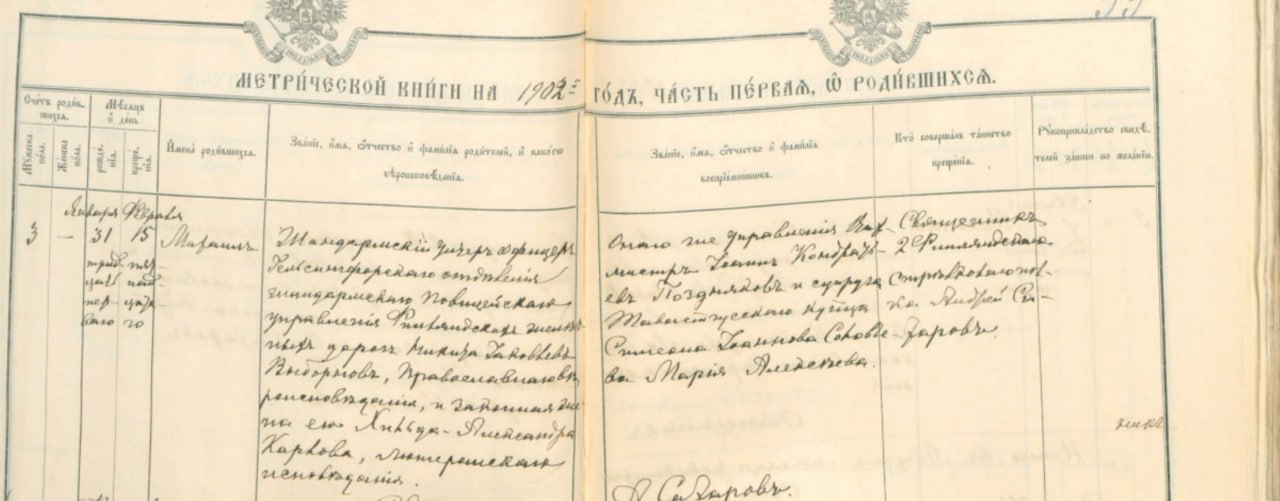 The record is shown as evidence; the translation follows in the text.
Metrical book for 1902, Part One — Births. Entry No. 3. Born 31 January, baptised 15 February. Name given: Mikhail.
Parents: Nikita Yakovlevich Vybornov, gendarme non-commissioned officer of the Helsingfors division of the Gendarme Police Administration of the Finnish Railways, of the Orthodox confession, and his lawful wife Hilda Alexandra Karlovna, of the Lutheran confession.
Godparents: Ioann Kondratyevich Pozdnyakov, sergeant-major of the same administration, and Maria Alexeyevna, wife of Stepan Ioannovich Serov, a merchant of Tavastehus.
Baptism performed by Father Andrei Sakharov, priest of the 2nd Finnish Regiment.
An index would have given us a name and a date. The register gave us his mother — and a whole household with her: a father with a rank and a posting, a colleague from the same railway administration standing as godfather, a local merchant's wife beside him. Godparents were rarely strangers. Each name is a thread.
And because a register is a book and not a search result, we kept turning pages. Two more children appeared: Pavel in 1904, Anna in 1907.
Anna's entry follows the same formula, but not word for word — clerks recorded a person's origin in whatever detail they had that day, so the same man can be described differently three times in one book. Here the line naming her father runs longer: he is entered as coming from the peasantry of Tver province, the village of Khlopovo.
The family had always assumed he was Finnish. He wasn't; he had come north to serve on the railways. That one clause, in an entry about somebody else, moved the search six hundred kilometres east into a different archive.
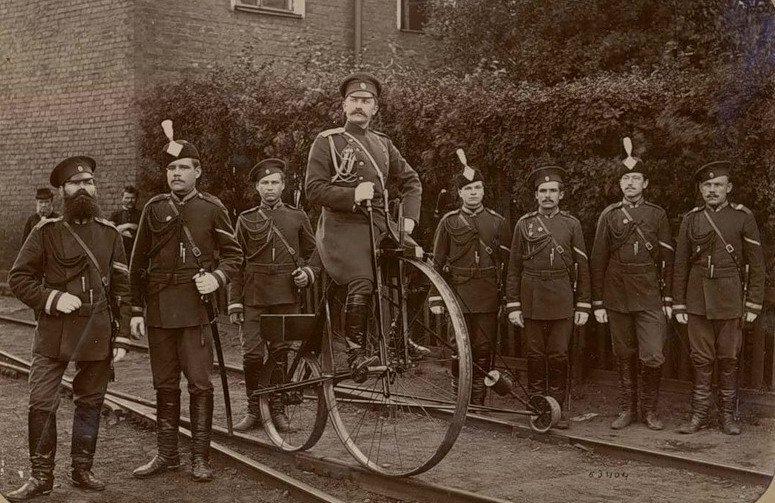 Gendarmes of the Russian railway police, 1870s–1900s — the service Nikita Vybornov had come north to join.
This is why "I found her on Ancestry" and "I have her record" are two different states of research — and why families who stop at the first hit a ceiling a generation later.
A word about legends
This story ends happily: a rumour became a register entry, then a christening record, then a documented family in the Swedish archives. It often goes the other way — a noble ancestor turns out to be a village clerk, a "German" turns out to be Alsatian, a birthplace is off by two hundred kilometres. Legends aren't lies; they're memory, compressed along a chain of people who each remembered slightly differently.
Either way the rule is the same: treat everything you were told as a hypothesis until a document confirms it. Family stories are excellent at telling you where to look, and unreliable about what you'll find.
What you can do yourself, free
- Interview your relatives — today. One correctly remembered village name is worth more than any database.
- FamilySearch — digitized metrical books from some regions, patchy but occasionally miraculous. Start with the catalogue, not the search box.
- Soviet WWII databases — free, in Russian, and often the fastest route to a birthplace.
- Arolsen Archives — the largest collection on victims of Nazi persecution, including Soviet POWs and forced labourers. English interface, free.
- JewishGen — the best starting point for Jewish roots.
- Russian-language resources — Familio, the VGD forum, Yandex Archives, regional archive portals — go further still, all in Russian.
Some Russian government sites, including Pamyat Naroda, may not load from outside Russia without a Russian VPN. If a link doesn't open, that's usually why — not a sign the records are gone.
Where to start when Ancestry has nothing on your Russian ancestors
Look at what one day produced. A great-great-grandmother who began as a rumour now has a name, a birth date, parents, a confession and a village. Her husband turned out to come from a province nobody had mentioned, two more children appeared, and a Swedish cousin's thousand-person tree had been sitting there all along, waiting for someone to know which name to type.
And it didn't stop with us: with a name, a place and a direction in hand, our client carried on alone into the Finnish archives, where she came face to face with her great-great-great-grandmother.
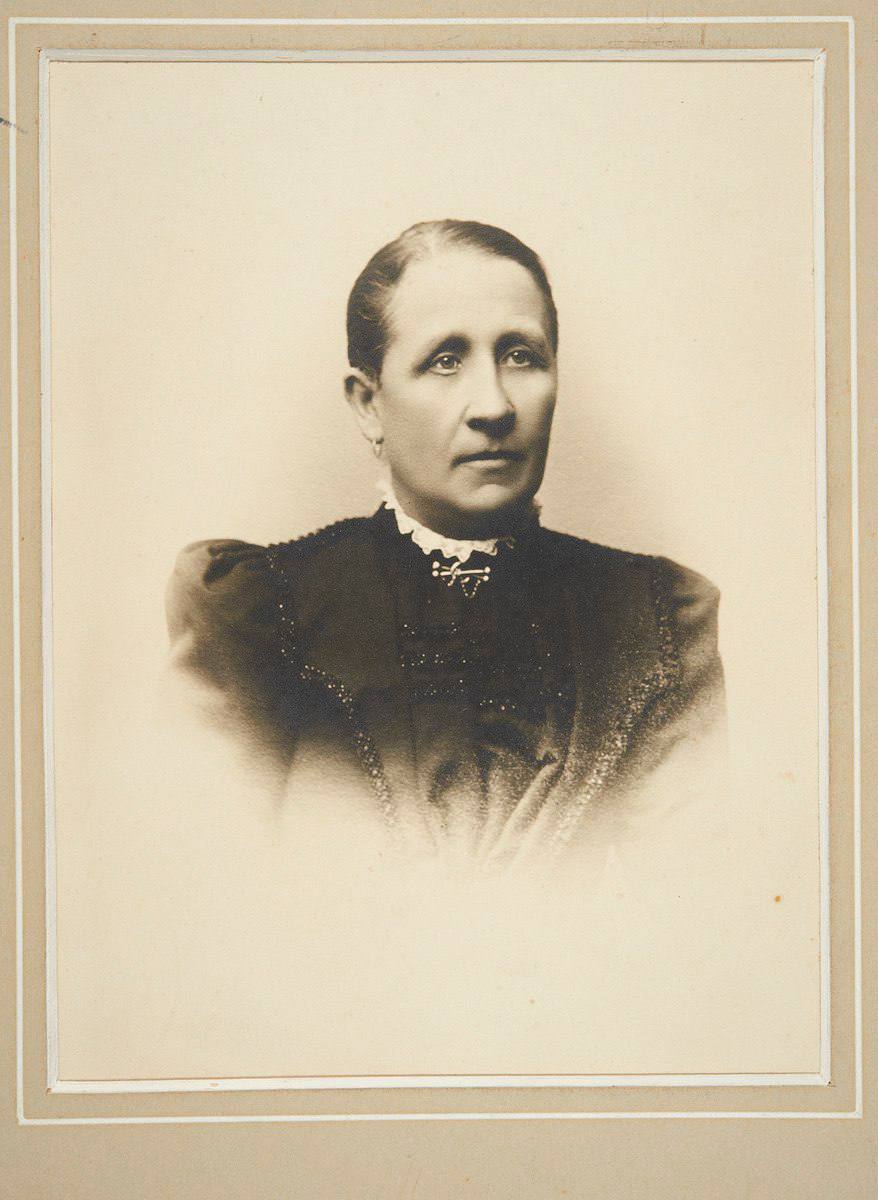 Hilda Alexandra's mother, found by our client herself. A search that began with a rumour ended with a face.
None of it required a reading room. It required knowing which questions to ask, in which order, of which sources — and being able to read the answers in 19th-century Russian.
That's what Archive Rats does. Our starting point is Scout Research (€250): we sort out what's documented and what's still legend, search the open sources and archival catalogues, and come back with what we found and where the trail leads next. You end up knowing what's findable before committing to finding it, and the fee counts toward a full project if you go on.
Have a specific question?
Let’s see what can be investigated
Send us what you know: names, dates, places, a family legend, an unusual document or a question that has been unresolved for years. We will review the starting point and suggest whether there is an archive route.
Book a Scout ResearchFrequently asked questions
Does Ancestry or MyHeritage have any Russian Empire records at all?
Some — mostly indexed collections for the western provinces and substantial Jewish community collections, plus emigration-side documents. For the core of the empire, coverage is close to zero.
Should I cancel my subscription?
No. Keep it for the emigration side and for DNA matching. Just stop expecting it to work east of the border.
My family says we're "from Russia," but I don't know the town.
Find it on the arrival side, in the language of the country your family settled in: French naturalisation dossiers are often remarkably detailed, interwar refugees left Nansen passport paperwork, Britain kept aliens' registration records, and US naturalization petitions and manifests name a birthplace. Expect the name spelled four different ways — transliteration had no standard, so search for the sound, not the spelling.
Can I write to a Russian archive myself?
Yes, and some answer foreigners — but the request usually has to be in Russian, in the expected format, with a precise question: a specific parish and year range, not "everything about the Ivanovs." Replies take weeks to months, and fees are hard to pay from abroad. (How to request records →)